 Posted On: 02/10/2026
Prelude Through a Frosted Lens: Why Winter Evidence Makes or Breaks Your Personal Injury Claim
Hidden hazards of black ice and snow piles that alter the duty of care
Black ice looks like wet asphalt, yet it transforms a routine sidewalk into a concealed skating rink. Drivers, store owners, and municipalities owe a heightened duty of care whenever invisible glaze coats pavement. Concealed hazards require additional signage, salt, or rerouting; ignoring those steps often triggers a cause of action for premises liability. When you photograph the reflective sheen at dawn, you capture proof that the property owner failed to mitigate an obvious danger. Combine images of unshoveled snow piles blocking drainage with notes on recent temperature swings, and comparative fault arguments quickly crumble.
Snow piles themselves become deceptive obstacles that redirect pedestrian flow into traffic lanes. A towering bank can hide an oncoming car, turning a normal crosswalk into a blind corner. Experienced investigators measure pile height, distance from curb, and angle of obstruction to show foreseeability. Those measurements align with winter personal injury resources that catalog municipal codes on snow removal. By contextualizing photos with local regulations, a personal injury lawyer near you converts icy inconveniences into compelling liability narratives.
How prompt documentation influences the insurance company narrative
Timing shapes every conversation with an insurance company after a motor vehicle accident on slick roads. A time-stamped image taken minutes after impact freezes the scene before tire spray erases crucial skid patterns. Dashcam footage showing brake lights flickering on black ice gives adjusters little room to suggest reckless speed. Similarly, documenting snowstorm injuries at the emergency room secures medical bills that match storm intensity, supporting claims for both economic and emotional distress damages. The sooner those assets enter your evidence locker, the harder it becomes for insurance companies to spin alternative stories.
Memories fade faster than snowflakes on a salted highway, so witness statements must be captured while adrenaline still surges. Encourage bystanders to describe visibility, temperature, and surface conditions in their own words. Their fresh recollections corroborate physical injury photos and property damage reports, reinforcing a narrative of unavoidable peril. Immediate preservation also satisfies chain-of-custody requirements, blocking defense counsel from alleging tampering. Fast, organized documentation ultimately shifts negotiation power toward the injured party and away from profit-driven insurers.
The role of a personal injury lawyer near you in triaging early proof
A seasoned personal injury attorney functions like an emergency room triage nurse for evidence. They prioritize collecting icy sidewalk slip and fall proof, securing surveillance video, and notifying defendants of potential spoliation claims. Because deletion windows on convenience store cameras shut quickly, counsel rushes subpoenas to preserve digital trails. Meanwhile, paralegals catalog damaged clothing, analyze accident reports, and align snowfall totals with municipal plow logs, ensuring no detail slips through frozen cracks.
Local knowledge further amplifies your case. Attorneys in snowy jurisdictions understand which intersections chronically freeze, which landlords cut corners on salt, and which hospitals code frostbite injuries accurately. Their familiarity with regional standards turns ordinary photographs into persuasive exhibits. By aligning your physical injuries with known trouble spots, the legal representative dismantles defense theories of unforeseeable danger. Engaging counsel early converts raw data into courtroom-ready evidence, accelerating negotiations toward a fair settlement.
1) The Photographic Freeze Frame Principle: Capturing Snow and Ice Before It Melts
Time stamped accident photos that pin down the property damage location
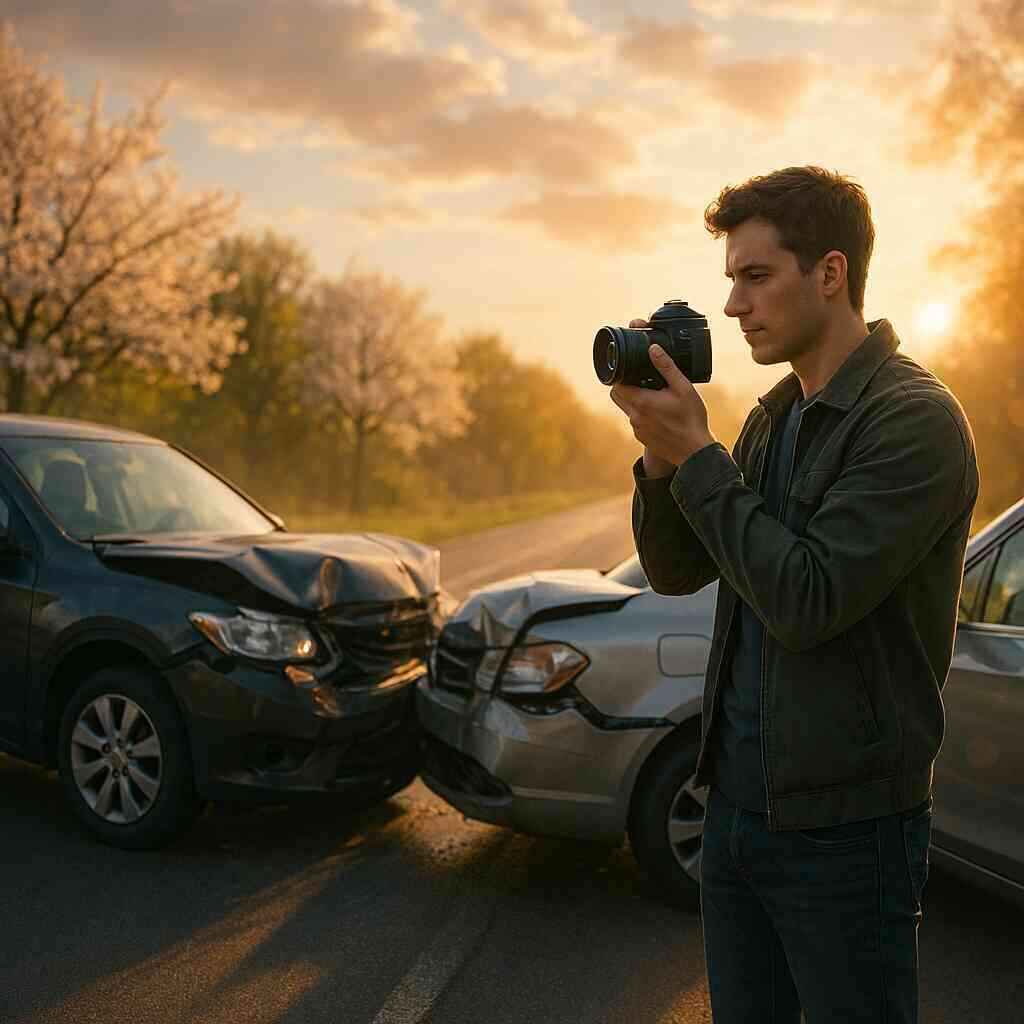
Seconds after a winter crash, your cell phone becomes the most powerful evidence tool you own. Activate the built-in timestamp, then photograph every dent, crack, and displaced bumper from several angles. Those digital markers freeze both location and chronology, preventing an insurance company from later alleging the wreck occurred elsewhere. Double-check that the device clock matches official time on nearby storefront receipts; consistent metadata reinforces authenticity. For extra clarity, narrate while recording a slow 360-degree video, describing landmarks, traffic signs, and approaching vehicles.
After still shots, capture wide-angle images that place property damage in relation to fixed objects like lamp posts and hydrants. These contextual frames build a spatial narrative that jurors easily visualize during a personal injury lawsuit. If snowfall intensifies, wipe the lens frequently so flakes do not obscure the crumpled fenders. You can reinforce the technique by reviewing the breaking down cold-weather evidence steps tutorial before you even hit the road. Proper spacing, consistent exposure, and time sequencing transform a simple gallery into courtroom-ready proof.
Lighting tricks for revealing black ice on roadways and sidewalks
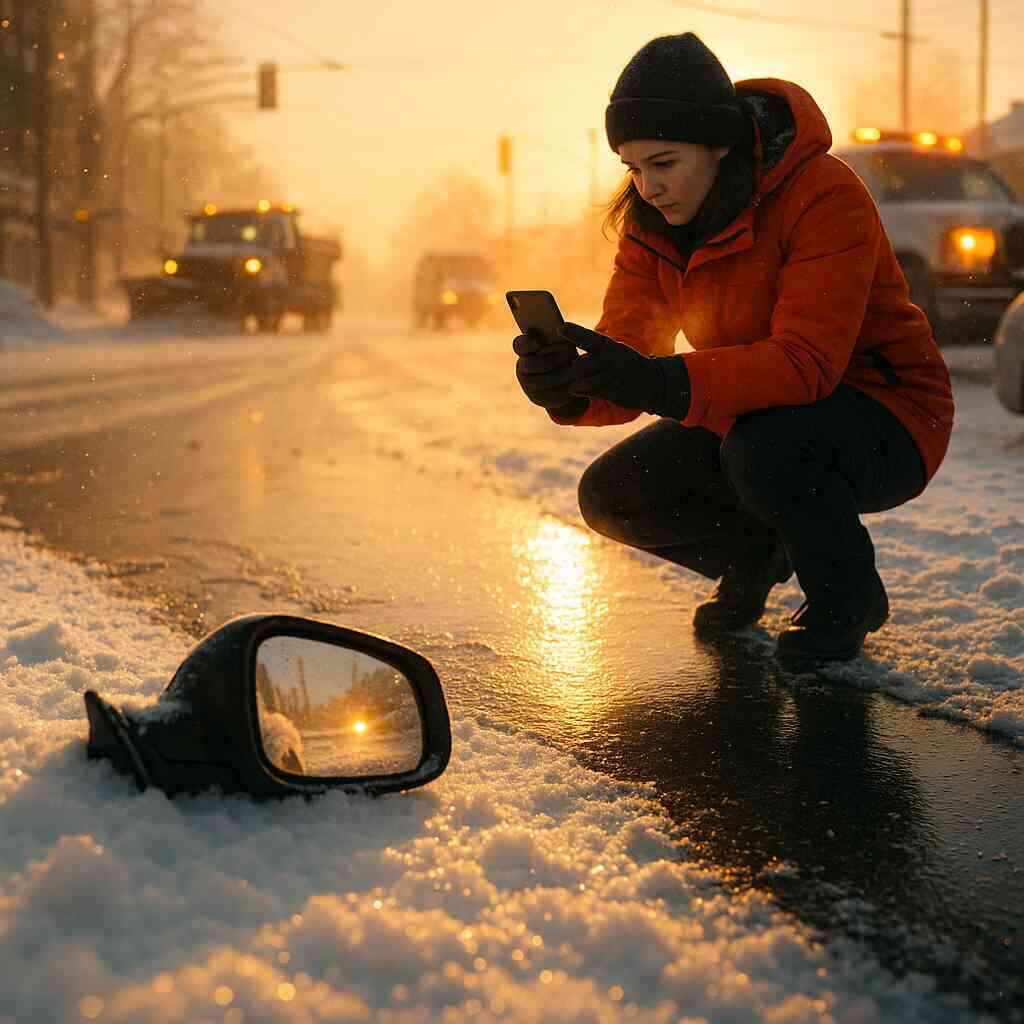
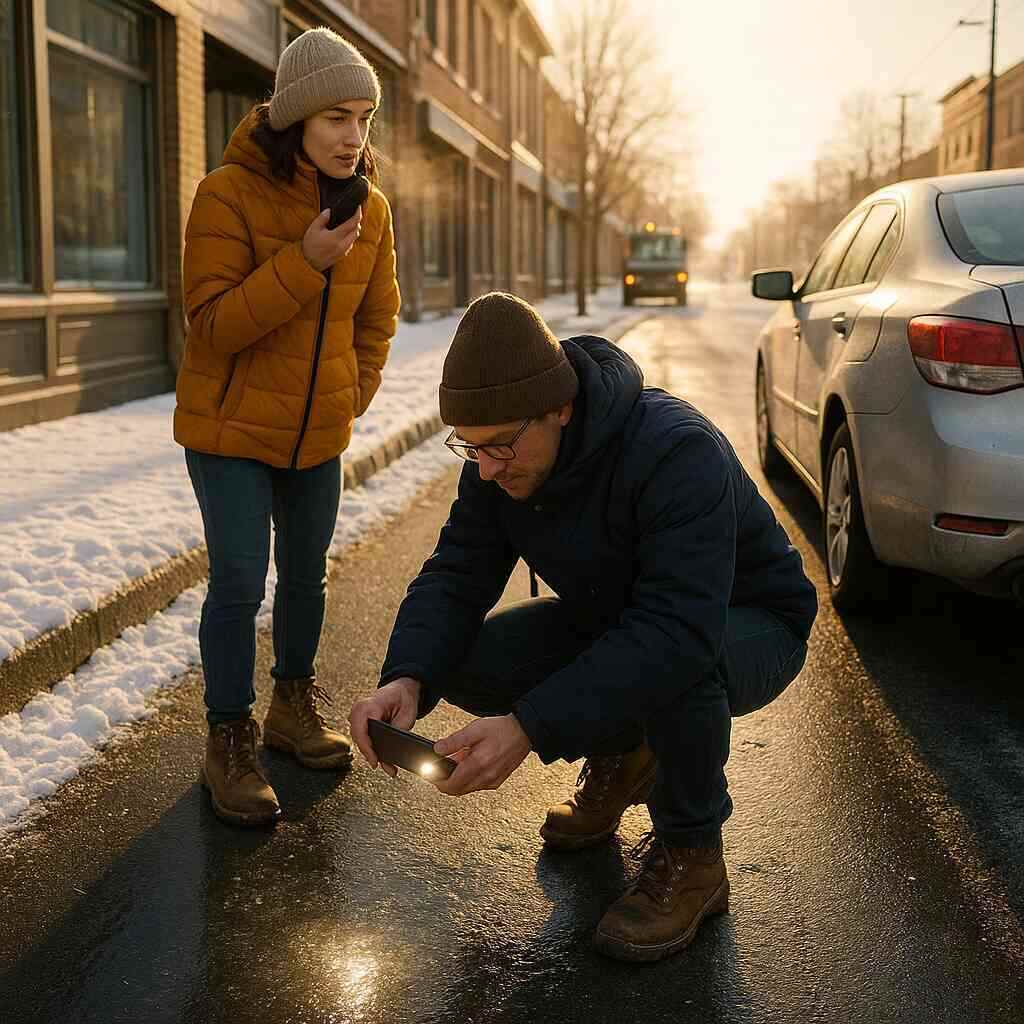
Black ice hides in plain sight because its glassy surface mimics wet asphalt under street lamps. To expose it, crouch low and angle your smartphone flash across the pavement. The sideways light creates glare that the camera captures as a silvery streak. Take several shots while rotating your stance every few degrees, ensuring reflective variations highlight thickness. Nearby headlights, store neon, or a small tactical flashlight also work when municipal lighting fails. Each illuminated frame corroborates that invisible danger existed, rebutting defense claims of open and obvious hazards.
Adjusting white balance prevents the bluish tint of snow from washing out the reflected sheen. Select a manual setting or tap the screen until the ice edge appears crisp and color-true. After shooting, immediately back up files to cloud storage and an external drive, locking metadata in place. These lighting hacks have prompted insurers to pay policy limits, say skilled lawyers in Ohio for slick road wrecks. Their case studies show that a single glare-rich image can outweigh pages of argumentative adjuster notes.
Chain of custody tips for physical injury photos taken on smartphones
Courts respect digital photographs only when you can prove they traveled an unbroken evidentiary path. Treat your phone like sealed evidence the moment you finish documenting bruises, lacerations, or frostbite. Rename files with unique identifiers that include initials, sequence numbers, and location abbreviations instead of descriptive words. Immediately email copies to your personal injury attorney so the email server provides an independent timestamp. Preserve the original device in airplane mode until your legal team extracts a forensically sound copy.
Next, draft a brief evidence log noting who handled the phone, when transfers occurred, and where backups reside. This living document deters defense accusations of photo editing because every custody point has a human witness. Store the log with your medical bills and police report so critical paperwork stays unified. Personal Injury Law Locator emphasizes that organized evidence prevents costly discovery disputes and slashes attorney fees during depositions. Adopting these habits turns your smartphone gallery into a transparent, attack-proof timeline.
Incorporating dashcam video to corroborate slip and fall angles
A stationary dashcam facing the sidewalk can capture a slip and fall as clearly as it records a rear-end collision. Position the lens to frame the vehicle hood, curb, and pedestrian path, creating geometric reference points for forensic experts. When you later freeze frames, you can measure stride length, impact velocity, and body orientation relative to snow piles. Synchronize the video clock with your smartphone photo timestamps to weave a seamless chronology. Even muffled audio, like crunching ice, augments claims of surface hardness and temperature.
Transfer raw dashcam files to two separate drives before reviewing them, maintaining pristine originals for accident reconstructionists. Most devices stamp GPS coordinates that complement municipal plow records and streetlight outage reports, solidifying the liability story. Share a password-protected folder with your legal team. Then archive an encrypted copy in cloud storage geographically distant from your residence. These extra steps thwart spoliation arguments and reassure jurors of evidence integrity. The result is a persuasive multimedia mosaic that insurance companies find difficult to refute.
2) The Witness Echo Effect: Securing Human Testimony Amid Winter Chaos
Collecting on scene statements while adrenaline is high and memories are clear
Adrenaline sharpens perception, so bystanders often recall tiny winter accident details that cameras miss. Approach witnesses calmly, identify yourself as the injured person or helper, and request their immediate account. Use your phone’s voice recorder, confirming their name, contact, and vantage point before questions begin. Encourage sensory descriptions such as tire squeals, ice cracking, or salt spray because those cues support future accident reconstruction. Finish by reading the summary back to them, ensuring accuracy and demonstrating respect that later fosters cooperation.
Swift documentation also protects against memory decay caused by cold exposure and shock. People leaving the scene may later blend events or underestimate hazards if prompted only days afterward. Secure two copies of every audio file: one goes to your personal injury lawyer and one remains in cloud storage. Add a simple note in your evidence log that lists witness order, location, and any physical injuries they observed. These disciplined steps turn fleeting impressions into durable courtroom testimony.
Recording municipal plow schedule discrepancies cited by nearby residents
Local residents track plow patterns instinctively because snow dictates daily routines. When they complain that city trucks skipped a block or delayed salt spreading, record their statements with equal care. Ask for specifics: time windows, audible equipment, or visible flashing lights. Cross reference their recollections with publicly posted plow schedules obtained through open-records requests. Any mismatch strengthens your cause of action by showing negligent maintenance despite foreseeable danger.
Photograph untouched snow ridges, then pair the images with resident timestamps for extra credibility. A well-kept evidence chart that aligns these facts will impress an insurance company adjuster. Your legal team can later subpoena GPS data from municipal vehicles, validating community claims. Together, human testimony and digital breadcrumbs construct a persuasive narrative of breached duty of care. Jurors often empathize with neighbors who warned officials long before your injury occurred.
Using the Personal Injury Law Locator to locate additional eyewitnesses fast
Crowded winter scenes hide witnesses who leave before first responders arrive. Personal Injury Law Locator maintains a nationwide network of investigators who canvass nearby businesses, buses, and rideshares within hours. They review security footage, electronic fare logs, and social media check-ins to identify overlooked observers. Once names emerge, your personal injury attorney issues preservation letters, ensuring those individuals stay available for deposition. Swift outreach also discourages insurance companies from contacting witnesses first and shaping their narrative.
Geographic reach matters when incidents occur near state borders or tourist zones. If your slip happened during a ski vacation, an investigator may trace guests who have already flown home. By coordinating with representatives in Minnesota for snow slip lawsuits, the platform locates travelers, secures sworn statements, and forwards them to your primary law firm. This multistate approach keeps your evidence pool rich, preventing defense counsel from arguing that neutral witnesses do not exist. The service thus becomes an essential bridge between raw events and polished testimony.
Preserving emergency 911 call recordings to reinforce emotional distress claims
A frantic 911 call captures panic, pain, and real-time observations that written reports cannot match. Request the audio through a formal records application filed promptly because agencies often purge files after short retention periods. Your personal injury lawyer near you will cite the recording to authenticate weather conditions, traffic flow, and the injured party’s physical injury symptoms. Emotional tone documented on tape supports compensation for emotional distress, a damage category insurers routinely undervalue. When jurors hear your trembling voice, they connect instantly with your suffering.
Maintain a verbatim transcript alongside the digital file to aid searchability during discovery. Note speaker identities, ambient noises such as sirens or crunching snow, and any statements by other callers patched into the line. Store the file on encrypted media, then log each access event to preserve the chain of custody. Integrate the call timing with medical treatment records to show seamless progression from crisis to care. This layered evidence strategy leaves insurers little room to dispute severity or causation.
 3) The Digital Trail Doctrine Leveraging Dashcams 911 Calls and Surveillance in Cold Weather Collisions
 3) The Digital Trail Doctrine Leveraging Dashcams 911 Calls and Surveillance in Cold Weather Collisions
Retrieving convenience store video before automatic deletion windows expire
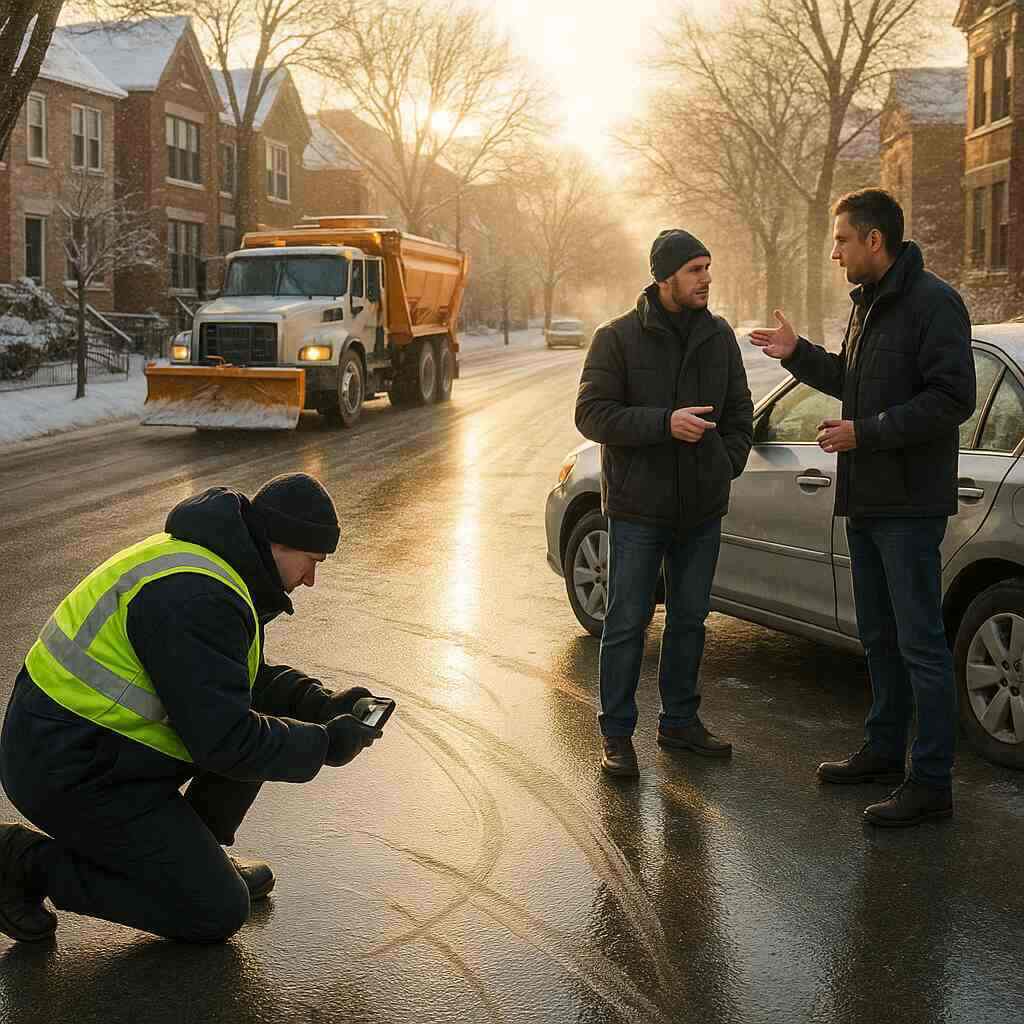
Cold weather crashes frequently unfold beside gas stations or corner marts equipped with high-definition cameras. Those systems routinely overwrite files every few days, erasing priceless winter accident evidence just as insurance companies begin their investigations. Send a preservation letter immediately, then visit the manager and politely request a backup copy while the snow still covers the lot. Bring a flash drive and shoot a photograph of the screen that displays file names, timestamps, and camera angles to confirm authenticity. For additional guidance, review our linked comprehensive accident proof handbook that details each step.
After securing footage, duplicate it onto two encrypted drives, labeling each with the incident location, your initials, and a sequence code. Store one copy with your personal injury lawyer near you and place the other in a fireproof safe, creating a clear chain of custody. Draft an evidence log noting who handled the media, when transfers occurred, and any password protections applied. These precautions stop an insurance company from alleging spoliation or later questioning file integrity. Early action transforms grainy lobby video into courtroom-ready proof that pinpoints negligent drivers and hazardous snow piles.
Archiving telematics from smart vehicles in a motor vehicle accident
Modern cars capture speed, steering angle, and brake application in onboard modules that mirror airplane black boxes. In an icy collision, this telematics data reveals whether the driver adapted to slick pavement or recklessly accelerated into black ice. Request a download through an automotive engineer or dealership before routine maintenance wipes the memory clean. Understanding how those numbers interact with impact physics deepens your personal injury claim and forces insurers to negotiate on facts, not speculation. The collected data complements public information on traffic collisions and strengthens your liability narrative.
Ask your legal team to draft a spoliation notice so opposing parties cannot reset the module during repairs. Next, store raw files on read-only media and print summary graphs highlighting speed trends just before impact. Align the timecode with dashcam frames to confirm synchronization across devices. Courts appreciate this multi-source validation because it reduces the margin for manipulation. By treating telematics as irrefutable science, you turn a simple skid into conclusive proof of negligence under personal injury law.
Capturing salt truck GPS data to expose negligent road treatment
Municipal and private salt trucks broadcast real-time GPS coordinates that show where and when they treated icy streets. An injured party can subpoena those logs to demonstrate dangerous gaps in coverage, especially during extended blizzards. If records prove trucks bypassed your intersection, the city’s duty of care weakens, boosting settlement value. Residents already rely on legal support in Alaska for icy mishaps to expedite these requests because local counsel knows which agencies hold specific datasets. Quick retrieval prevents servers from archiving or purging winter routes.
Once obtained, overlay GPS paths onto a satellite map and mark your crash location with a bold icon. Highlight time stamps that show plows passed before temperatures dropped again, allowing black ice to reform. Present these visuals alongside witness testimony describing untreated slick spots, creating a persuasive evidentiary mosaic. Insurance companies often capitulate when faced with municipal logs contradicting their safe-road arguments. Your organized approach illustrates why diligent evidence collection wins personal injury cases stemming from winter negligence.
Aligning electronic logs with certified weather reports for undeniable timelines
Electronic driver logs, 911 dispatch records, and hospital intake sheets each carry precise digital timestamps. Synchronizing those records with snowfall totals and wind-chill readings builds a timeline that even experienced defense attorneys find hard to challenge. This method applies classic tort elements explained in the linked explanation of negligence principles. When every independent source echoes the same minute-by-minute story, causation becomes nearly self-evident.
Begin by requesting certified snow depth and temperature reports from the National Weather Service. Match those figures against dashcam metadata, salt truck GPS trails, and your emergency call audio. Any discrepancy immediately flags potential data tampering by the opposing side. Present the harmonized chart during mediation to demonstrate airtight liability, minimizing drawn-out litigation. Such precision empowers your law firm to negotiate favorable compensation for medical bills, property damage, and emotional distress without unnecessary attorney fees.
4) The Tangible Texture Test: Preserving Damaged Clothing, Footwear and Ice Samples for Courtroom Impact
Retaining torn winter coats and snow boots that show the force of impact
Preserving torn winter clothing as evidence transforms frayed threads into a silent witness that no insurance company can ignore. Seal ripped coats and cracked snow boots in separate, breathable containers to prevent mold while locking in road salt residue. That residue, once tested, links your garments to the specific crash scene and strengthens your personal injury claim. Photograph every zipper tear before storage, then catalog the items in a detailed chain-of-custody log. For deeper guidance, review our comprehensive guide to filing winter slip claims before boxing anything up.
Label each container with date, location, and your initials, mirroring evidence room standards that seasoned personal injury lawyers follow daily. Never wash blood stains or de-ice chemicals away, because those compounds help accident reconstructionists measure the force of impact. Store the boxes in a climate-controlled space, not a damp garage, to protect fabric integrity. When presenting these articles in court, your legal team can have a biomechanics expert correlate specific rips with body movement, illustrating how the injury occurred. The visual impact of jagged seams often persuades jurors more powerfully than any written report.
Maintaining frozen ice cores in controlled conditions to prove surface thickness
Collecting an ice core from the exact slip spot captures surface thickness that photographs alone cannot convey. Use a clean steel corer, slide the sample into an insulated tube, and mark depth measurements immediately. Transport the tube on dry ice to a certified laboratory, maintaining the temperature below freezing to avoid sublimation. Lab technicians then document the crystal structure, revealing whether untreated black ice or compacted snow caused the fall. Share those scientific findings with attorneys in Illinois on black ice crashes for comparison, as their published verdicts highlight how precise thickness data dismantles defense arguments.
Always log who handled the core, when transfers occurred, and the thermometer readings during transit. Courts scrutinize every custody step, so meticulous notes eliminate spoliation claims. Pair the lab report with meteorological data showing temperature swings that allowed refreezing, linking municipal negligence to your physical injuries. Presenting hard science alongside damaged footwear gives the jury a full sensory experience. That blend of tactile and empirical evidence often accelerates settlement talks.
Documenting frostbite progression through medical treatment photos
Frostbite injuries evolve quickly, so schedule sequential photographs at every treatment milestone under hospital lighting for consistency. Each image should include a medical ruler, capturing swelling and discoloration that prove ongoing physical injury. Ask the treating nurse to initial the photo log, reinforcing authenticity that insurance companies respect. Your legal team can then align image timestamps with billing records to calculate non-economic losses, such as emotional distress. These visual chronicles echo principles in the overview of personal injury law, which stresses demonstrating both initial harm and lasting damage.
Beyond photos, preserve hospital discharge summaries detailing debridement, grafts, or hyperbaric therapy. Keeping that paperwork with your images streamlines negotiations, because adjusters see an undeniable correlation between treatment intensity and rising medical bills. Consistent documentation also counters allegations of delayed care, which insurers use to minimize payouts. By combining visual and textual proof, you create a narrative that withstands meticulous cross-examination. The approach showcases how a comprehensive evidence strategy directly boosts compensation.
Demonstrating slip resistant footwear wear patterns to refute comparative fault
Opposing counsel often claims worn soles caused the accident, shifting blame onto the injured person. Defuse that tactic by photographing your footwear’s tread with macro lenses under uniform lighting, capturing every groove. Next, supply purchase receipts showing recent acquisition, proving the soles were originally slip-resistant. A forensic podiatrist can then compare tread depth with industry standards, confirming adequate traction. If you expect insurer pushback, review unmasking insurer tactics after snow accidents for preemptive counterarguments.
Store the shoes in archival bags with desiccant packs to halt further degradation and odor. Document any embedded grit, as those particles can match road materials found at the crash site. Present tread maps side-by-side with ice core data, illustrating that environmental factors, not footwear neglect-caused the fall. Finally, if questions arise about evidence handling, immediately contact the Personal Injury Law Locator team for expert guidance on maintaining unimpeachable chain-of-custody procedures. Solid preservation techniques shift comparative fault discussions firmly in your favor, paving the way for full and fair recovery.
5) The Meteorological Paper Trail Strategy Using Certified Weather Data and Municipal Logs to Prove Liability
Obtaining National Weather Service certifications that validate snowfall totals
Insurance companies often argue that snowfall amounts were minor, hoping to undermine your personal injury claim. Certified reports from the National Weather Service instantly silence that defense because they carry governmental authority. Your legal team submits a simple written request, then receives a signed certificate that lists the exact accumulation near the accident location. By pinning an objective number to the storm, you connect slippery conditions directly to the motor vehicle accident or icy sidewalk slip and fall proof already been gathered. Jurors respect federal data far more than opinion, so this document becomes the cornerstone of your winter accident evidence collection.
Next, organize the certificate within an evidence binder that already holds medical bills, property damage photos, and witness statements. Place a copy in digital cloud storage and reference it in every insurance claim letter for consistency. Seasoned adjusters know that falsifying or disputing a federal record exposes them to bad-faith allegations. Consequently, negotiations often speed up once snowfall totals are locked beyond debate. Because damages escalate with storm intensity, correlating the certificate with treatment invoices supports accurate economic and non-economic valuations. For deeper context on valuation principles, see how courts measure understanding damages in civil cases.
Tracking salt truck activity logs to identify negligent snow removal gaps
Municipal salt truck GPS logs reveal whether road crews treated intersections promptly or skipped them entirely. Request these electronic records through a freedom-of-information application or subpoena, then overlay route timestamps on a neighborhood map. When gaps appear around the crash site, liability shifts toward the city or contracted plow company. Your personal injury attorney highlights these omissions during settlement talks, demonstrating foreseeability and breached duty of care. Such technical evidence often outweighs anecdotal accounts because it shows systematic negligence rather than isolated error.
Should local officials resist, enlist expert counsel in Colorado on blizzard collisions who routinely extract municipal data under tight deadlines. Their experience forces quick compliance, preventing servers from auto-deleting GPS files. Once secured, match log gaps with your time-stamped accident photos and witness testimony. This triangulation makes comparative fault arguments crumble, especially when the injured person was using proper snow tires or walking on a cleared path. By proving that government vehicles never appeared, you build undeniable momentum toward full compensation for physical injuries and emotional distress.
Matching emergency room discharge times with storm intensity charts
Hospitals time-stamp every admission, treatment, and discharge event, creating an unassailable medical chronology. When those times align with rising storm intensity charts, you establish that injuries occurred during peak danger, not afterward. Start by obtaining certified weather radar images that track snowfall rate minute by minute. Then place the images beside your emergency room paperwork, drawing lines that connect treatment milestones to precipitation spikes. The visual timeline convinces both jurors and insurance companies that delayed care was impossible, undercutting attempts to minimize compensation.
To strengthen credibility, your personal injury lawyer near you can share the synchronized chart with technical experts who calculate impact forces based on snow density. Their conclusions amplify the objective medical records already in play. If additional legal muscle becomes necessary, quickly find nearby injury attorneys through Personal Injury Law Locator for co-counsel or venue transfer. Collaborative representation sends a clear message that the injured party refuses to accept lowball offers. Ultimately, matching medical and meteorological clocks crafts a storyline so coherent that adjusters seldom risk trial.
Analyzing streetlight outage reports that contributed to reduced visibility
Darkness magnifies danger on frozen pavement, yet municipalities sometimes ignore streetlight outage complaints for weeks. Access public works maintenance logs to pinpoint when bulbs failed near your collision. Compare failure dates with the accident evening to show that reduced visibility exacerbated black ice or snow pile hazards. Photographs of the dark intersection, taken immediately after impact, further corroborate negligent lighting maintenance. Together, these records transform a routine premises liability debate into a compelling narrative of compounded municipal neglect.
After securing outage data, integrate it with witness statements describing sudden darkness and glare from oncoming traffic. Your legal team may consult experienced attorneys in Texas for winter pileups to model how similar lighting failures boosted verdicts elsewhere. Present the combined evidence during mediation, emphasizing that multiple preventable factors converged to cause severe personal injuries. Because layered negligence increases potential punitive damages, insurers often elevate settlement offers rather than face a jury. By spotlighting every overlooked bulb, you illuminate the broader pattern of cost-cutting that jeopardized public safety.
The Thaw and the Verdict: Converting Cold Facts into Fair Compensation with Personal Injury Law Locator
 The Thaw and the Verdict: Converting Cold Facts into Fair Compensation with Personal Injury Law Locator
Calculating cumulative medical bills and lost wages from winter injuries
Medical expenses mount quickly after an icy crash. Emergency care, diagnostic imaging, and ongoing physical therapy each generate separate invoices. Your legal team compiles every charge into a single spreadsheet, letting you see the true scope of medical bills. They then add pharmacy receipts, adaptive equipment costs, and projected rehabilitation estimates, creating a realistic future-care column. Finally, they document lost wages by collecting payroll records, supervisor statements, and disability certificates, translating missed shifts into hard numbers a jury understands.
Precise math supports higher settlement demands because insurers value concrete proof. Attorneys often enlist vocational experts who explain how frostbite or spinal damage limits future earning capacity. These specialists contrast pre-injury career paths with reduced options, reinforcing claims for diminished earning potential. By pairing expert testimony with meticulous receipts, your lawyers transform abstract suffering into quantifiable economic damages. The result is an evidence-driven damages model that survives even the toughest cross-examination.
Drafting a compelling personal injury lawsuit narrative that blends all five evidence pillars
A persuasive winter injury complaint reads like a well-structured novel, yet every detail rests on documented fact. The opening paragraphs set the scene with time-stamped photographs of black ice, instantly anchoring liability. Next, witness statements echo through the narrative, confirming visibility conditions and vehicle speed. Digital trails from dashcams and telematics appear as supporting characters, providing objective confirmation. Tangible exhibits-ripped coats, ice cores, and worn snow boots-add tactile depth jurors can visualize from the jury box.
Attorneys weave these threads together using clear, chronological language that highlights foreseeability and breach of duty. Transition words guide the reader from one evidence pillar to the next, maintaining momentum. Emotional distress claims gain authenticity through 911 call transcripts and medical treatment photos, ensuring the human story remains central. Throughout, the complaint cites statutes, case law, and safety regulations, satisfying legal sufficiency while keeping the narrative gripping. This balanced approach compels courts and insurers alike to take the claim seriously.
Negotiating from a position of strength against insurance companies with your legal team
Preparation fosters leverage. Before any negotiation session, your attorneys create a settlement brief that mirrors trial exhibits, leaving nothing for insurers to question. They open talks by presenting synchronized timelines that align salt-truck gaps with certified weather data, immediately framing liability as undeniable. When adjusters attempt lowball offers, counsel counters with actuarial charts linking injury severity to lifetime costs, dismantling cost-containment arguments.
Strong evidence also limits comparative fault tactics. Photographs of slip-resistant footwear, paired with expert analysis, refute claims of claimant negligence. Digital vehicle logs prove responsible driving, undercutting reckless-speed allegations. Because every assertion stands on verifiable proof, insurers recognize that extended litigation risks a higher verdict. Consequently, many carriers choose prompt, equitable settlements, saving you months of stress and preventing unnecessary attorney fees.
How Personal Injury Law Locator accelerates access to top personal injury attorneys in every state
Speed matters when winter evidence can melt, fade, or be deleted. Personal Injury Law Locator connects injured parties to vetted attorneys within moments, no matter the state. A single query delivers contact information for specialists in car accidents, premises liability, or wrongful death, streamlining the legal process. Need premises liability guidance in New York during winter? The platform instantly matches you with seasoned counsel experienced in local snow-removal ordinances.
National reach ensures uniform quality. Whether your motor vehicle accident occurs on a rural Alaskan highway or a bustling Florida parking lot, you receive comparable expertise. The Locator’s database highlights peer reviews, verdict histories, and language options, fostering informed choice. By uniting injured people with high-caliber representation quickly, the service preserves fragile winter accident evidence, strengthens civil cases, and maximizes compensation potential.
Frequently Asked Questions
Question: How quickly should I start collecting winter accident evidence after an icy crash, and what specific items does Personal Injury Law Locator recommend gathering first?
Answer: Move immediately-within minutes if you can safely do so-because snow, sleet, and black ice can melt or be plowed away before an insurance company finishes its first phone call. Personal Injury Law Locator encourages every injured person to begin by taking time-stamped accident photos, recording witness statements while adrenaline is high, and preserving any torn winter clothing as evidence. These steps lock down skid marks, snow pile locations, and the exact condition of your snow boots, all of which are crucial when you file a personal injury claim. Once you contact a personal injury lawyer near you through our platform, your legal team will widen the net to include dashcam video, certified weather reports for the accident day, and municipal plow or salt-truck activity logs. Fast, organized action prevents insurers from rewriting the narrative and positions you for maximum compensation on medical bills, property damage, and emotional distress.
Question: In the Top 5 Winter Evidence Tips by Personal Injury Law Locator, you stress photographing black ice at the crash scene. What lighting tricks actually reveal that nearly invisible hazard?
Answer: Black ice is notorious for blending into asphalt, so you need to create glare that your camera can capture. Crouch low, angle your smartphone or dashcam light across the pavement, and let the sideways beam highlight the glassy surface. Rotate a few degrees between shots and adjust white balance so the ice edge stays color-true. Headlights, store neon, or even a small flashlight will work when streetlights fail. Always keep the built-in timestamp active to prove the exact moment you recorded the hazard. These lighting techniques, combined with chain-of-custody safeguards (backing up originals to the cloud and emailing copies to your attorney), give your personal injury law firm courtroom-quality evidence that insurance companies find hard to refute.
Question: How does maintaining a chain of custody for damaged winter clothing-like ripped coats or cracked snow boots-strengthen my icy sidewalk slip and fall proof?
Answer: Treat your clothing like forensic evidence. Seal each item in a breathable container, label it with your initials, date, and location, and log every hand-off. Road salt residue, embedded grit, and blood stains can all link the garment to the precise accident site. When your personal injury attorney presents these items in court, a biomechanics expert can correlate each tear with body movement, vividly proving the force of impact. Because Personal Injury Law Locator connects you with law firms that follow strict evidence protocols, the defense cannot credibly allege tampering. That airtight chain of custody often forces the insurance company to abandon comparative-fault arguments and negotiate a fair settlement for your physical injuries and lost wages.
Question: Can Personal Injury Law Locator really obtain municipal snow removal logs, salt-truck GPS data, and certified snowfall totals fast enough to help my winter accident case?
Answer: Yes. Our nationwide network of personal injury attorneys knows exactly which public-works departments, weather stations, and private contractors hold the data you need. The moment you retain a lawyer through Personal Injury Law Locator, they issue preservation letters and file freedom-of-information requests so electronic records aren’t auto-deleted. By overlaying GPS routes with National Weather Service certifications, your legal team can pinpoint negligent snow removal gaps and match them to your motor vehicle accident or slip-and-fall timeline. This digital-paper trail strategy makes it nearly impossible for insurance companies to dispute liability, accelerates settlement negotiations, and often increases compensation for medical treatment, future care costs, and non-economic damages.